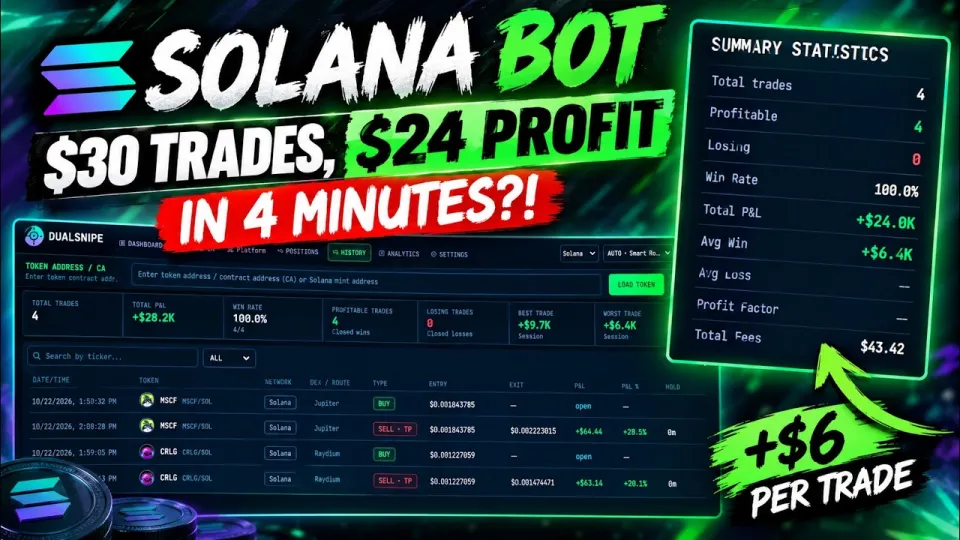
Solana bot in action shows how four automated trades closed in profit in about four minutes
· based on the channel DualSnipe Labs
Key takeaways
- Four Solana trades closed in profit in roughly four minutes in the demo session.
- Profit averaged about $6 per trade on positions of around $30, roughly 20% per position.
- The bot exits via pre-set take-profit orders rather than manual selling.
- Routing spans multiple Solana DEXs, including Jupiter, Raydium, Meteora, Orca, Phoenix, Lifinity, OpenBook and Pump.fun venues.
- The tool is distributed as a desktop terminal at dualsnipe.com/api/download and as a Telegram web app called DualDex.
A Solana bot is software that watches Solana markets and places buy and sell orders automatically according to rules you set, so entries and exits happen without you clicking. In the session published by DualSnipe Labs, the bot closed four trades in profit in about four minutes, averaging roughly $6 per trade on positions of around $30. The tool is offered through the DualSnipe website, which hosts the product and its download links.
What a Solana trading bot actually does
A Solana trading bot connects to on-chain liquidity and executes orders on your behalf, turning a strategy into repeatable actions. On Solana this matters more than on slower chains: blocks land in well under a second, and a new token can go from launch to a liquid pool in minutes. Manual trading at that pace means watching charts constantly and reacting late.
The core loop of a bot like the one shown is simple:
- Scan new pools and existing pairs for a trigger condition (volume spike, liquidity threshold, a specific mint appearing on a DEX).
- Build and sign a swap transaction, choosing the route with the best price across venues.
- Submit the order with priority fees tuned to current network conditions.
- Place the exit: a take-profit target, a stop-loss, or both.
- Log the result in a trade history with realized P&L.
Everything in the DualSnipe session follows that pattern. The interesting part is not that a bot can buy a token; it is that the exit was pre-defined, so the position closed on a rule rather than on a feeling.
The four-trade session in numbers
The demo run is short and that is the point: four trades, all closed green, in about four minutes of screen time. The description states approximately $6 profit per trade on positions of around $30. That works out to roughly 20% per position before fees, which is a useful sanity check when you read any bot marketing.
A few observations from the numbers:
- Four trades in four minutes means the bot was cycling capital quickly, not holding overnight.
- At $30 per position, the absolute profit is small; the percentage is what matters for evaluating a strategy.
- Each trade needed both an entry and an exit inside that window, so latency and routing quality carry most of the weight.
- A single four-minute sample says nothing about the next four minutes, let alone the next four hundred trades.
The channel frames the clip as a specific trading session rather than a performance record, and that framing is correct. Treat the session as a demonstration of mechanics: order flow, take-profit execution, and P&L tracking working together.
How the exit and take-profit logic works
The exit rule is the part of a Solana sniper bot that decides whether a strategy survives. In the session, positions closed at a pre-set target, which is why four trades could complete so quickly. Three exit designs dominate:
- Fixed take-profit: sell the whole position at a set percentage gain. Simple, predictable, and what a four-minute cycle implies.
- Scaled exits: sell part at the first target and let the rest run with a trailing stop. Slower, but captures larger moves.
- Hard stop-loss: the non-negotiable leg. Without it, one bad entry erases many small wins.
On Solana, exits are complicated by slippage and liquidity. A token with thin pools can show a 20% gain on the chart while an actual sell fills far lower. Good bots estimate price impact before submitting and can split an order across routes. When you evaluate any Solana meme coin bot, ask what happens when the pool thins mid-trade, not just what the take-profit percentage is.
Multi-DEX routing across Jupiter, Raydium, Meteora and more
A Solana DEX bot is only as good as its routing, because Solana liquidity is fragmented across many venues. The tag list around this tool names most of them: Jupiter as the aggregator, Raydium and Meteora for pooled liquidity, Orca for concentrated positions, Phoenix, Lifinity and OpenBook for order-book style trading, and Pump.fun and PumpSwap for launch-phase tokens. Data tools like DexScreener, Birdeye and GMGN feed scanners, while interfaces such as Photon, BullX, Axiom, Trojan, Maestro and Banana Gun compete for the same trader.
Practical implications of fragmentation:
- The best price for a small order may sit on a venue you would never check manually.
- Routing through an aggregator reduces the chance of a bad fill but adds a dependency on that aggregator's uptime.
- Launch-phase tokens on Pump.fun often have no deep pool at all, so position size has to stay small.
- Priority fees and compute budget settings decide whether your transaction lands before or after everyone else's.
For a $30 position, routing differences are measured in cents, but the same logic scales: a bot that picks the wrong venue on a thin pair can turn a winning trade into a losing one.
Common doubts about automated Solana trading
The questions that come up most around bot demos are about fees, safety and whether the results are real. They are fair questions, and the honest answers are unglamorous.
Fees first. Every round trip on Solana costs network fees, priority fees and swap fees, plus any platform fee the bot charges. On a $30 position, those costs can easily eat a meaningful share of a 20% gain, which is why the net number matters more than the gross one.
Safety second. Any bot that asks for your private key or a wallet connection with unlimited approval is a risk you are taking on the operator, not just the market. Prefer tools that keep keys local, limit approvals, and let you revoke access. A desktop terminal such as the one distributed at dualsnipe.com/api/download keeps execution on your machine, which is a different trust model from a hosted web app.
Consistency third. Four winning trades in four minutes is a highlight, not an average. Anyone evaluating a Solana trading bot should ask for a longer track record with losing trades included, because a strategy that only wins in clips is not a strategy.
Where to get the bot and what each link is for
The tool is distributed through three entry points, each serving a different workflow:
- DualSnipe website — product overview, features and access to the trading system.
- Desktop trading terminal download — the local application for automated execution on your own machine.
- DualDex Web App on Telegram — a browser and mobile-friendly interface inside Telegram for trading without installing the desktop client.
If you are testing a Solana bot for the first time, start with small positions like the $30 size shown in the session, confirm that take-profit and stop-loss orders actually fire, and only then consider scaling. Keep a written record of every trade so the bot's P&L log can be checked against reality.
Conclusion
The session from DualSnipe Labs shows the mechanics of a Solana bot doing what it is built for: four trades opened and closed in profit in about four minutes, around $6 per trade on $30 positions, with take-profit execution and multi-DEX routing handled automatically. The numbers are small and the sample is short, so the clip is best read as a demonstration of speed and process rather than proof of edge. What it does illustrate clearly is why automation fits Solana: sub-second blocks and fragmented liquidity reward tools that react faster than a human can. If you want to see the same workflow yourself, start at the DualSnipe website and test with position sizes you can afford to lose.
Questions & answers
How much can a Solana bot realistically earn per trade?
There is no fixed answer, but the session shown averaged about $6 profit on positions of around $30, roughly 20% before fees. Network fees, priority fees, swap fees and any platform fee come out of that, so net results are lower. Treat any per-trade figure as a sample, not an expectation.
Is a Solana trading bot safe to connect to my wallet?
It depends on the trust model. Bots that keep keys and signing local to your machine, such as a desktop terminal, expose you to less counterparty risk than hosted services that hold or request your private key. Always limit token approvals and revoke access you no longer use.
Do I need coding skills to run an automated Solana sniper bot?
Usually not. Tools in this category ship as a desktop application or a Telegram web app with settings for position size, take-profit and stop-loss. The real skill is choosing parameters and risk limits, not writing code.
Why do bot demos always show winning trades?
Because a demo is a selected session, not an average. Four green trades in four minutes say nothing about the next hundred, and losing trades are rarely featured. Ask for a longer record that includes drawdowns before trusting any strategy.
Source: Solana Bot: 4 Winning Trades in 4 Minutes?! · Markdown version